
Markets end almost flat, bluechips in focus.

The Adani group will have understood the fragility of investor trust in the group. The group needs to improve transparency including in areas like share-ownership (which they have long and mistakenly believed can be side-stepped) and related-party transactions, among others, Amit Tandon and Hetal Dalal point out.

Rising crude oil prices and muted passenger traffic in the July-September quarter (second quarter, or Q2) of 2023-24 (FY24) have raised concerns about the profitability of listed aviation players. These two concerns have caused the stock of InterGlobe Aviation (IndiGo), the largest player in the sector, to slip by 11 per cent since its highs at the end of July. Nuvama Research expects yields to cool down in the near term due to seasonality, rising crude oil prices, and higher capacity.

A sharp sell-off in the Indian equities markets after a spike in crude oil prices should not be surprising. Historically there is a negative correlation between stock valuations in India and the price of Brent crude oil, which is the benchmark for the Indian crude oil basket. Between 2011 and 2014, crude oil traded above $100 a barrel for an extended period, the Sensex-trailing price/earnings (P/E) was 18X, on average, during the period, nearly 22 per cent lower than the current index P/E of 23X.

The BJP is the preferred choice because it offers what the Mughals and later British offered in their time: A stable polity and an environment in which business could function, explains T N Ninan.

Markets continued to fall on Monday, with the Sensex declining 94 points as investors remained cautious amid unabated selling by foreign funds and elevated crude oil prices ahead of the RBI's policy decision later this week. The 30-share BSE Sensex declined 93.91 points or 0.17 per cent to end at 55,675.32. During the day, it tanked 473.49 points or 0.84 per cent to 55,295.74.

The broader NSE Nifty ended 57 points, or 0.49 per cent, lower at 11,498.90 in its fourth straight day of losses.

Focus will, however, shift back to corporate earnings, liquidity situation and global events - specially crude price.

Ajit Mishra, vice president, Research, Religare Broking, answers your queries.

Lower crude oil prices would impact India's inflation, CAD.
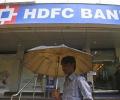
With the merger between HDFC Bank and HDFC Ltd complete, analysts said the next key monitorable for the Street would be successful resolution of merger-related hiccups, including employee-related churn and roll out of complete banking services across branches. At the bourses, they expect the stock to perform in-line with the benchmark indices in the near-term. "There's usually an initial period of consolidation after a merger as the entities work towards integration.

Indian money, foreign exchange, bond and stock markets are closed on Monday for Ambedkar Jayanti.

Tyre stocks have been on a tear over the past six months, with average returns exceeding 45 per cent. Except for Apollo Tyres, which has seen a slight correction in the last month and a half, limiting its gains to 16 per cent, listed peers such as MRF, CEAT Tyres (formerly Cavi Elettrici e Affini Torino), and JK Tyre & Industries have delivered returns exceeding 30 per cent during this period. Production-related constraints and sluggish demand in Europe, where sales are expected to remain flat, coupled with high valuations, have contributed to Apollo Tyres' underperformance. The tyre sector's gains can be attributed to robust growth trends driven by the replacement market, which constitutes more than two-thirds of sales.

Fear factors weights on markets, Sensex, Nifty struggle to keep pace.

Broader market underperformed the headline indices

The headline for corporate profit growth has been very encouraging in the July-September quarter (Q2) of 2023-24 (FY24), with the combined net profit of listed companies up by 38 per cent year-on-year. However, the earnings distribution has been very lopsided, with most of the growth coming from public-sector oil-marketing companies (OMCs), banks, non-bank lenders, automobile (auto) companies, and cement producers. By comparison, companies from information technology services, fast-moving consumer goods (FMCG), retail, and consumer durables were disappointed, experiencing a sharp slowdown in net sales growth and a relatively muted increase in reported net profit.

Hyundai Motor India Limited's (HMIL's) record Rs 27,870 crore initial public offering (IPO) may not have set the primary market alight with sky-high subscription levels, but it has spelled a windfall for the five investment banks steering the share sale. The Indian arm of the South Korean carmaker paid Rs 493 crore - 1.77 per cent of the issue size - in fees and commissions to the book running lead managers (BRLMs), marking the largest-ever payout for an IPO in the country.

Indians' belief in the country's economic future has diminished in the recent years, with the COVID-19 pandemic taking a further toll on sentiment while pushing many middle-class citizens into poverty, former RBI governor Raghuram Rajan has said. Virtually addressing an event organised by the NALSAR University of Law, Rajan further said the domestic stock market is booming but that does not reflect the reality that many Indians are in deep distress.

Global firm Accenture's fourth quarter results prove that the worst is behind for the Indian information technology (IT) sector, said analysts on Friday (September 27). While the pace and the broadness of recovery is debatable, they said Accenture's results and revenue growth guidance for the next financial year (FY25) reduce downside risks for Indian IT companies.

Adani Group stocks have taken a beating on the bourses after Hindenburg Research made a litany of allegations in its report, including fraudulent transactions and share price manipulation at the Gautam Adani-led group.

Sectorally, telecom, realty, auto and banks were among the top losers, shedding as much as 2.22 per cent.

A lot of gains have been driven by foreign portfolio investors. Lower interest rates globally have forced foreign investors to seek avenues for growth. They have been net buyers to the tune of Rs 2.5 trillion over the trailing 12 months, including May, reports Sachin P Mampatta.

From its lows this month, the stock of Sona BLW Precision Forgings is up 10 per cent on better-than-expected results. The stock rose by 4 per cent in the trading session on Tuesday after Japan's Nikkei Group said the Indian automotive component major has topped its rankings in terms of competitive advantage. The rankings are based on sales, profit margin, capital expenditure, research and development, and market capitalisation.

The migration of domestically developed intellectual property to foreign corporations within India reflects an anomaly in the demand pattern of the country's job market, points out Kanika Datta.

'We operate in 16 countries already, and therefore adding the UK to it, and beginning a chapter in the European continent is the next step.'


After last Monday's massive fall in the Indian markets, a lot of quality stocks have fallen significantly.

Titan was the top laggard in the Sensex pack, shedding 1.39 per cent, followed by HDFC, Axis Bank, Kotak Bank, HCL Tech and Tech Mahindra. On the other hand, Asian Paints, SBI, M&M, TCS, Bajaj Finserv and ICICI Bank were among the winners, spurting as much as 3.25 per cent.

'It is less dependent on imported capital.'

Among the Sensex firms, Axis Bank, Power Grid, Maruti, State Bank of India, Tata Motors, ITC, Nestle and Mahindra & Mahindra were the major gainers. Bajaj Finance and Larsen & Toubro were the laggards.
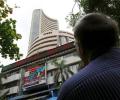
The S&P BSE Sensex ended 46 points lower at 24,824 and Nifty50 settled at 7,555, down by 8 points after hitting intra-day high of 7,600.45.
Markets snapped their 8-day winning streak.

A lot of mid and small-caps are in the bubble zone and command high valuation and have corrected sharply.
Stocks of companies having operations and exports to Europe were the top losers.

Debt-saddled telecom operator Vodafone Idea Ltd's Rs 18,000 crore follow-on offering (FPO) on Monday was subscribed more than 3.3 times, as institutional investors poured in money but the retail segment lagged. On the last day of the offering, as many as 4,212.56 crore shares were sought against the issue size of 1,260 crore at 14.30 hrs, according to information on stock exchanges.

Investors brace up ahead of the key macrodata- IIP and CPI numbers due to be unveiled tomorrow.

Companies spent less money buying back their shares from the public last year than at any time since 2015. They announced buybacks of up to Rs 14,341 crore, show numbers from primary market tracker Prime Database. The total amount spent was Rs 13,597 crore. Both the amounts are lower than what was offered (Rs 39,564 crore) and spent (Rs 36,517 crore) in 2020.
Indian companies are generating more cash than ever. The net cash flow from listed firms' operations hit a new high of Rs 11.1 trillion in financial year 2023-24 (FY24), crossing the Rs 10-trillion mark for the first time, according to the Centre for Monitoring Indian Economy (CMIE) data going back to 1990-91. The FY24 figure represents a 19.3 per cent jump over the previous year, even as quite a few companies are yet to release their numbers.

Milk supplies could improve with the monsoon, provided the rains are not excessive.

In the Sensex pack, 20 stocks ended in the red while 37 of the Nifty constituents closed the session with losses. NTPC was the biggest loser among the Sensex constituents, ending with a loss of 2.71 per cent.
